七夕节
Qixi: the magpie bridge and the art of threading a needle
The lovers in the sky explain one side of Qixi. The needlework people practised on earth explains why it was also called the Festival of Pleading for Skill.
Qixi Festival falls on the seventh day of the seventh lunar month. In 2027, it falls on Sunday, August 8.
Explore the history and local traditions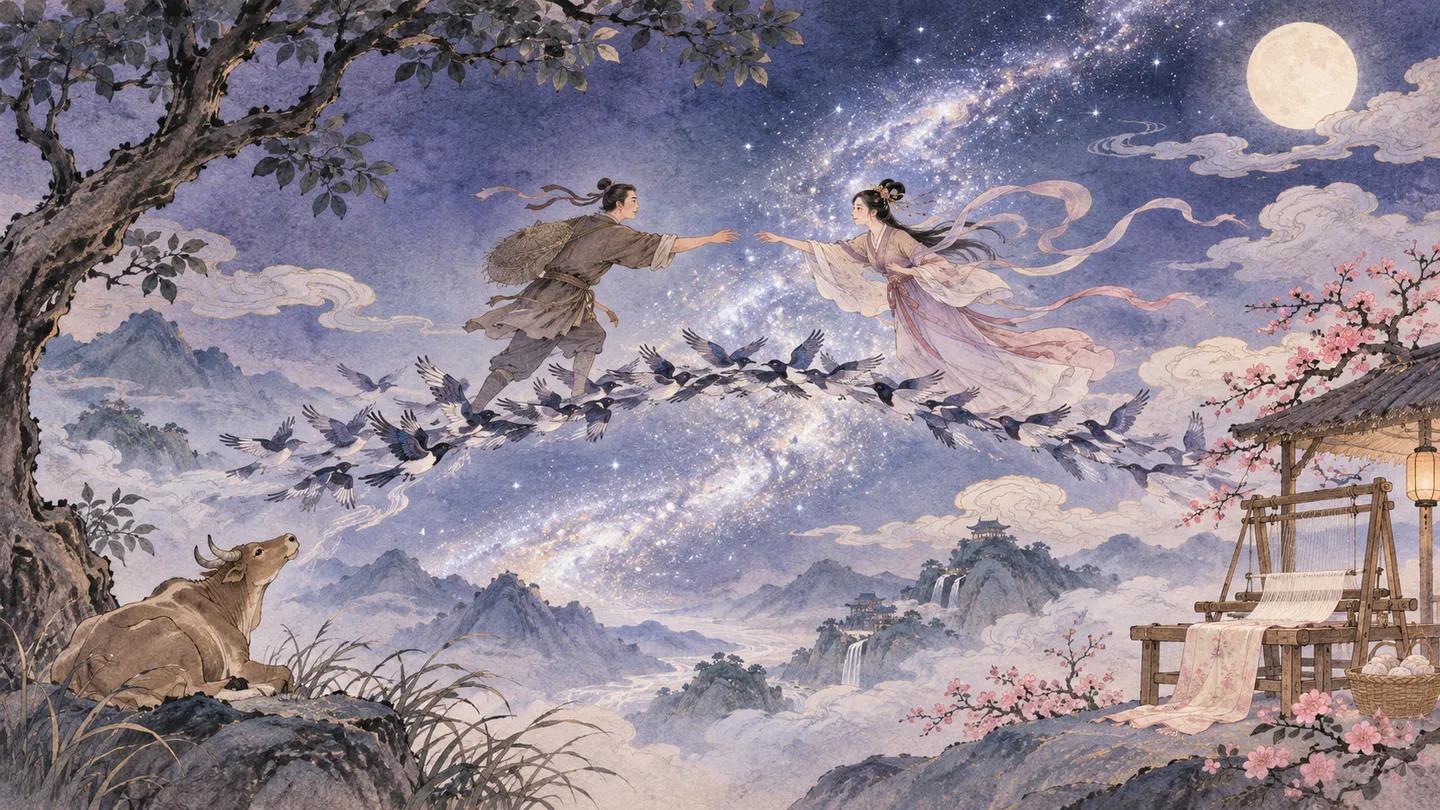
The night the Cowherd and Weaver Girl meet
In a well-known version of the folktale, the Weaver Girl leaves the heavens, marries the Cowherd and starts a family. They are separated by the heavenly river. On the seventh night of the seventh lunar month, magpies form a bridge so the two can meet. Local versions disagree about who permits the reunion or why, but the image of the bridge survives across retellings.
What people asked of the Weaver Girl
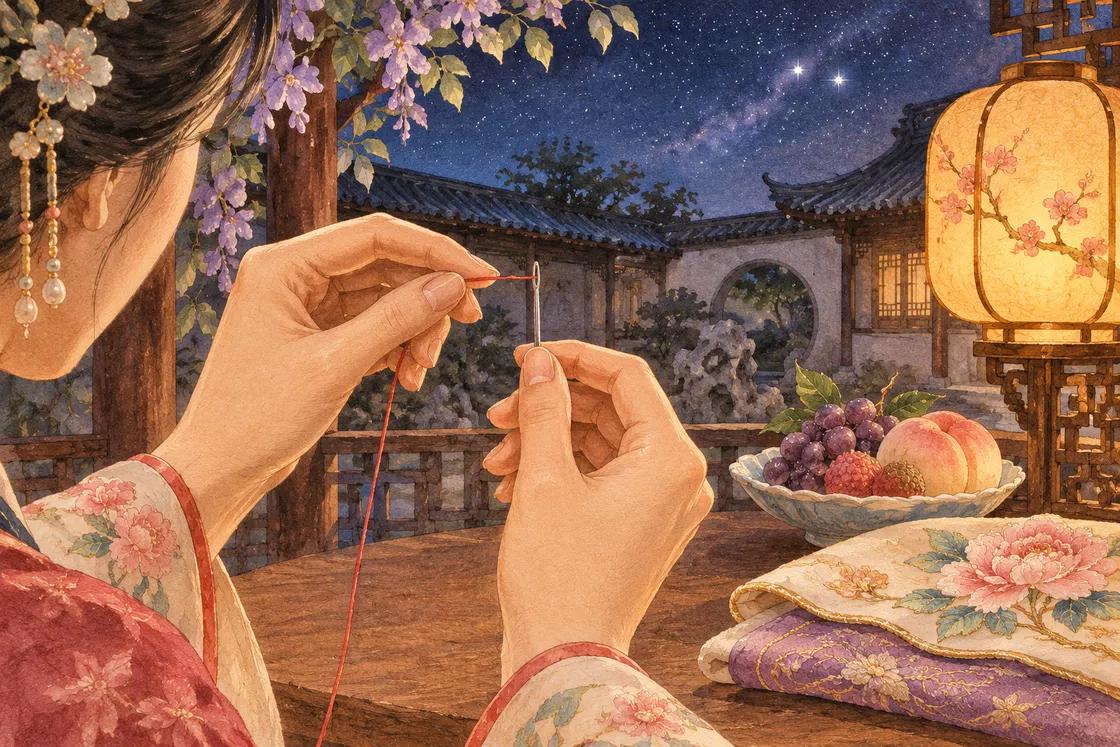
Qiqiao (乞巧) means asking for skill. Women in some communities tried threading needles at night, offered fruit or made objects for display. A heritage report from Hubei describes modern Qixi displays in Guangzhou’s Zhucun with crafted offerings. The modern romantic association of Qixi sits alongside that older focus on dexterity, ingenuity and making things by hand.
The three names readers encounter
- Qixi (七夕)
- The evening of the seventh day of the seventh lunar month.
- Qiqiao (乞巧)
- The observance associated with asking for skill.
- Chinese Valentine’s Day
- A modern name emphasising the lovers in the folktale.
The date is fixed in the lunar calendar at month seven, day seven, while its Gregorian date changes from year to year. Calling Qixi “Chinese Valentine’s Day” can be a useful modern shorthand, but it does not cover the full historical range of the festival or every local practice.
The history behind Qixi Festival
What did the Cowherd and Weaver Girl look like in early poetry?
The two figures are associated with bright stars: the Cowherd with Altair and the Weaver Girl with Vega. They are pictured on opposite sides of the Milky Way. A poem preserved in the Nineteen Old Poems imagines the Weaver Girl at her loom. She moves her hands, but her distress interrupts the work. The river looks close enough to cross, yet the two cannot speak to one another.
The focus on interrupted weaving matters. The poem gives the woman a craft and uses it to make her separation tangible. Later retellings supply fuller family stories and the bridge of magpies. A Song lyric by Qin Guan shifts the emphasis again, asking how lasting affection should be understood when meetings are rare. These works are different retellings and reflections, rather than consecutive episodes in one fixed story.
Xuchang cultural account of Qixi stars, lore and literary works
How did threading a needle become a festival test?
Qiqiao (乞巧) means asking for skill. The Weaver Girl’s work gives the request a concrete model. A local custom recorded in Xuchang’s cultural account calls for threading coloured silk through a needle with several holes by moonlight. A participant can show steadiness and patience, qualities that the story alone does not ask her to demonstrate.
Threading was only one version of the practice. The Ministry of Culture describes other tests and ways of displaying small handmade objects. Setting fruit or needlework out to be seen makes skill visible to relatives and neighbours. This helps explain why a festival now marketed around romance also has a long history of craft and aspiration.
What goes into a Qixi craft display in Guangzhou’s Zhucun?
The heritage account of Tianhe describes months of preparation. Groups assemble pieces for display, using materials that can include grains and sprouts as well as needlework and flowers. Displays include small towers, trays and model magpie bridges. In Zhucun the pieces may be set out for neighbours in halls traditionally used for community gatherings.
It is helpful to distinguish displaying the work, baiqiao (摆巧), from the act of paying respects to the Weaver Girl. A bridge model makes a familiar story visible, while the arrangement of ordinary materials makes the maker’s skill visible. That public dimension is what a one-line description of Qixi as a festival for couples leaves unexplained.
Intangible heritage report on Tianhe and Zhucun Qixi displays
Questions about Qixi Festival
When is Qixi Festival in 2027?
Qixi Festival falls on the seventh day of the seventh lunar month. In 2027, it falls on Sunday, August 8.
What is the story of the magpie bridge at Qixi?
In a widely told version, the Cowherd and Weaver Girl are separated by the heavenly river. Magpies make a bridge across it once a year so they can meet on the seventh night of the seventh lunar month.
Which stars represent the Cowherd and Weaver Girl?
The Cowherd is associated with Altair in Aquila, and the Weaver Girl with Vega in Lyra. The Milky Way between them is imagined as the heavenly river in the story.
Why is Qixi called Chinese Valentine’s Day?
The modern nickname highlights the reunion of the two lovers in the folktale. Historical Qixi customs also include qiqiao, asking for skill through needlework and other local practices.
How did people practise qiqiao during Qixi?
Some women tested their dexterity by threading needles, while others presented fruit or displayed handmade work. These practices varied by place and were associated with asking the Weaver Girl for skill.
Sources and editorial scope
- Hong Kong Observatory Almanac 2026 — Calendar table covering January–December 2027.
- People’s Daily source: Qixi origins and customs — Overview of the festival’s names, star traditions, and customs.
- Ministry of Culture account of Qixi and qiqiao
- Intangible heritage account of regional Qixi customs
- Zodiac Compass methodology and calculation sources — explains the calendar range used for dates on this site.
This page is a cultural and calendar reference. It does not claim that one legend, custom, or local practice represents every Chinese community.