小年
Little New Year: when the kitchen marks the start of the holiday
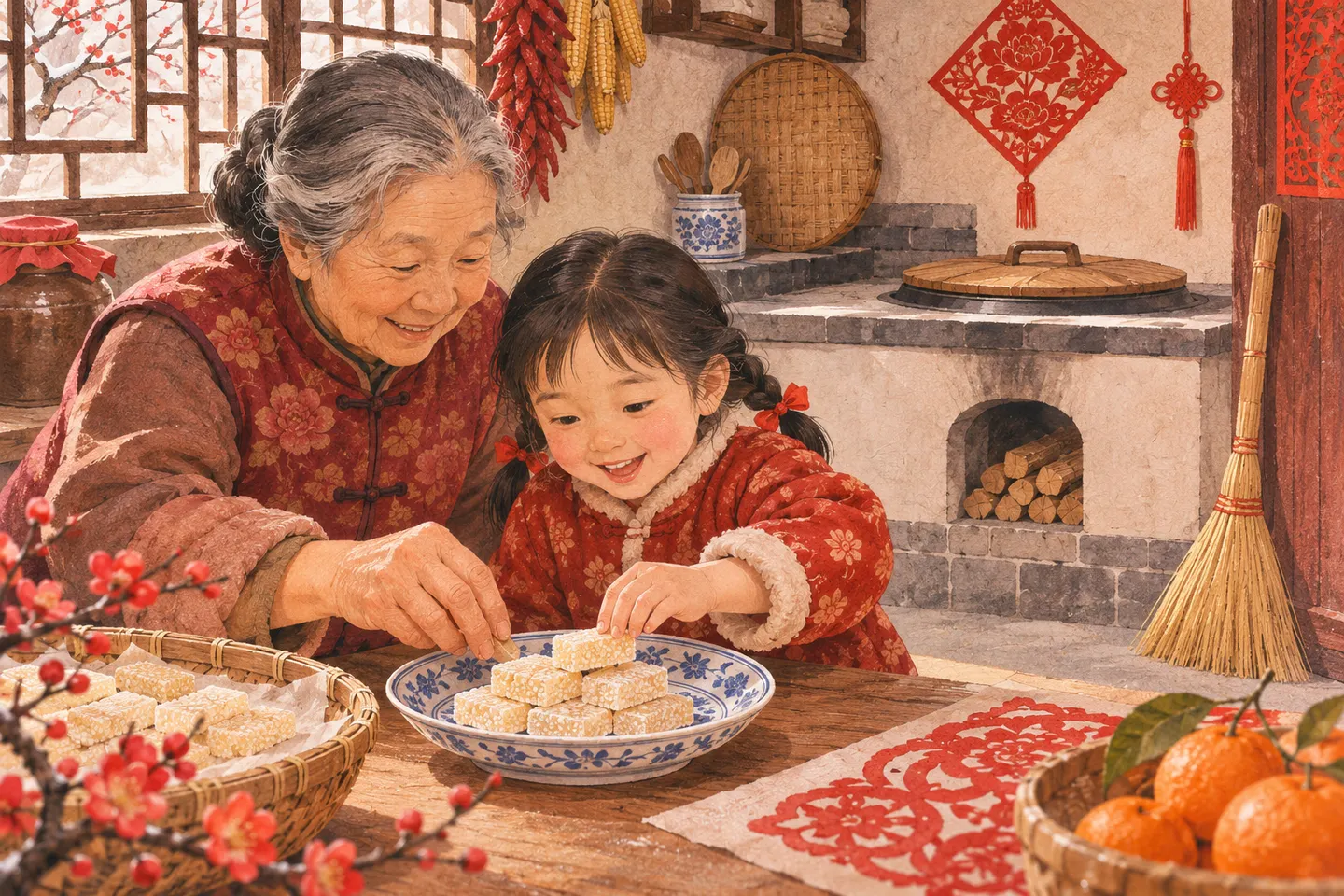
A plate of malt candy and a broom tell two sides of Xiaonian: sending off the Kitchen God and preparing the home for the year ahead.
Little New Year does not have one nationwide fixed date. Many northern communities observe it on the 23rd day of the twelfth lunar month, while many southern communities observe it on the 24th.
Why offer candy to the Kitchen God?
In a popular household story, the Kitchen God (灶王爷) goes to heaven near the end of the lunar year to report on the people who live around his hearth. Families in some places offer sticky malt candy, hoping he will deliver a favourable account. The details differ by locality. Historical descriptions from Hanzhong also mention offerings of sweets and fruit, while Huairou in Beijing records tanggua, a traditional malt-sugar sweet.

From the hearth to the front door
After the send-off, attention turns to preparing the house. Sweeping, washing, shopping for festival foods and putting up cut-paper decorations can take several days. The dates and tasks vary across families, which is why two relatives can remember Xiaonian differently and still be describing their own traditions accurately.
Why there are two dates in 2027
- January 30
- Lunar month 12, day 23. Common in many northern communities.
- January 31
- Lunar month 12, day 24. Common in many southern communities, with local exceptions.
For the lunar year ending in early 2027, the 23rd and 24th days of the twelfth lunar month fall on January 30 and January 31, 2027. The relevant date depends on local family and community practice. Do not assume that one date or custom represents all of China. Family practice, province, and local tradition can change both the date and the way the day is observed.
How did a kitchen offering become part of getting ready for Chinese New Year?
The hearth was a daily gathering place and, in households that observed the custom, the place associated with the Kitchen God. A local account from Hanzhong describes a send-off late in the twelfth lunar month, with fruit or sweets offered before the god’s journey. The story explains the choice of offerings: a sweet send-off might encourage a favourable report on the household.
The ritual and the practical work follow different timelines. A family may mark the send-off on one evening but spend the next several days cleaning, buying food and preparing for relatives. This is why Xiaonian can refer both to a particular local observance and to the moment when a family starts getting ready for the larger holiday.
Questions about Little New Year
When is Little New Year in 2027?
Little New Year does not have one nationwide fixed date. Many northern communities observe it on the 23rd day of the twelfth lunar month, while many southern communities observe it on the 24th.
Why are there two Little New Year dates in China?
Many northern communities mark the 23rd day of the twelfth lunar month and many southern communities mark the 24th. These are common regional conventions, and family and local traditions can differ.
What is the difference between Little New Year and Chinese New Year?
Little New Year is a period of preparation and, in some places, a Kitchen God observance before the year ends. Chinese New Year begins on the first day of the next lunar month.
Why do some families offer sticky candy to the Kitchen God?
In folk tradition, the Kitchen God reports on the household at the end of the year. An offering of sweet malt candy expresses the hope that he will speak favourably about the family.
Sources and editorial scope
- Hong Kong Observatory Almanac 2026 — Calendar table covering January–December 2027.
- National Office for Philosophy and Social Sciences: Chinese traditional festival system — A research overview of how major traditional festivals developed and changed over time.
- Hanzhong municipal account of the Kitchen God
- Huairou local customs and malt candy
- Zodiac Compass methodology and calculation sources — explains the calendar range used for dates on this site.
This page is a cultural and calendar reference. It does not claim that one legend, custom, or local practice represents every Chinese community.