重阳节
Double Ninth Festival: a climb through autumn
On the ninth day of the ninth month, a walk uphill can connect family time, autumn scenery and an old story about escaping danger.
Double Ninth Festival falls on the ninth day of the ninth lunar month. In 2027, it falls on Friday, October 8.
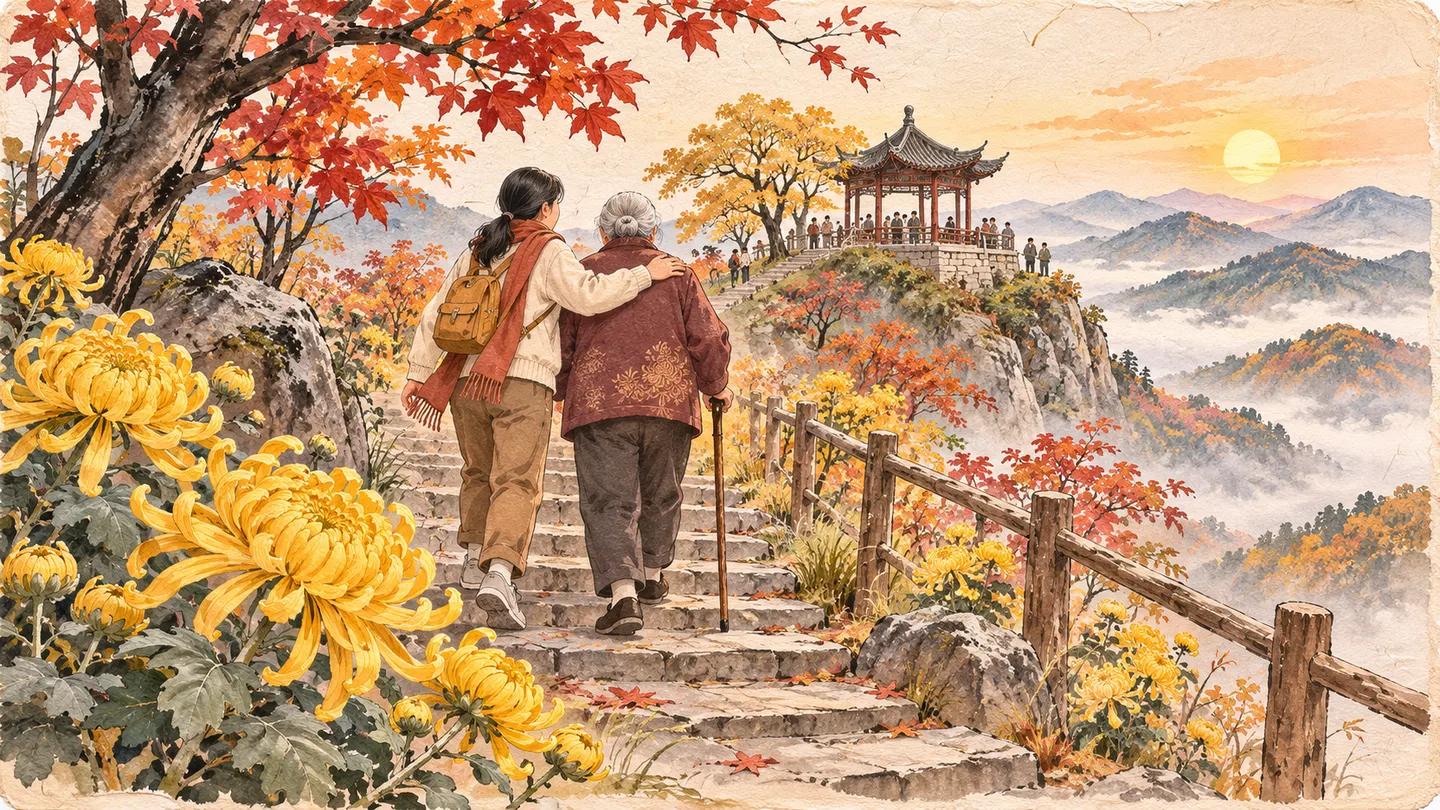
Why the ninth day is called Chongyang
Double Ninth names the date: the ninth day of the ninth lunar month. In traditional number symbolism, nine is a yang number, so the two nines give Chongyang (重陽) its name. Another association comes from sound: jiǔ (九, nine) sounds like jiǔ (久, lasting), so the repeated number can evoke longevity. The symbolism and the wordplay explain different aspects of the same festival.
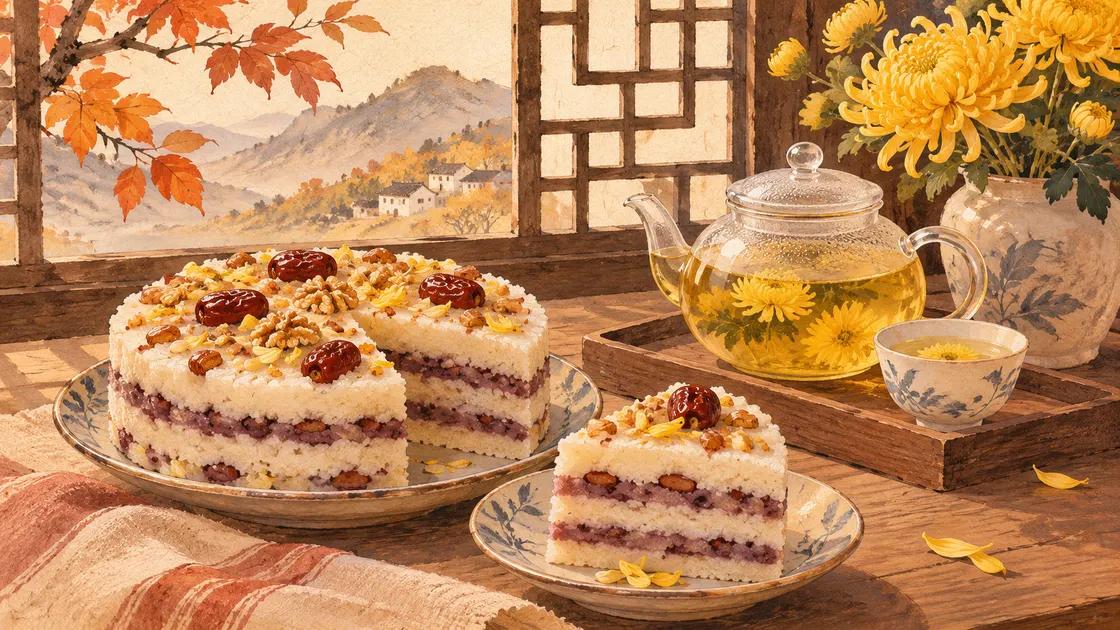
What makes a cake a Chongyang cake?
Chongyang gao (重陽糕) is a festival cake with regional variations. The word for cake, gāo (糕), sounds like the word for height, gāo (高). A Song-era description of cakes in Kaifeng mentions small cut-paper flags and toppings such as chestnuts and pine nuts. The layered cake pictured here is one interpretation of the festival food.
Huan Jing’s climb: the warning, the hill and the return home
In a tale preserved in Wu Jun’s Xu Qi Xie Ji (續齊諧記), the teacher Fei Changfang warns Huan Jing that disaster will strike his household on the ninth day. He tells Huan to make small pouches of zhuyu (茱萸) for his family, carry them on their arms, climb to high ground and drink chrysanthemum wine. Huan follows the instructions and takes his family out of the house.
When they return later that day, they find their domestic animals dead. Fei explains that the animals took the harm in the family’s place. The tale gives protective meanings to three customs at once: climbing high, carrying an aromatic plant and drinking chrysanthemum wine. It is a literary explanation for the customs, and other accounts show people climbing simply to gather and enjoy the season.
What Wang Wei does with the same ritual
Wang Wei’s Tang poem Remembering My Brothers on the Ninth Day of the Ninth Month starts with the feeling of being a stranger far from home. Then he moves the imagined viewpoint: his brothers are the ones climbing and wearing zhuyu, and from their side one person is missing.
The herb matters to the poem because it makes absence countable. Everyone in the imagined group shares the gesture, except the sibling who cannot be there. Where Huan Jing’s tale uses the climb to keep a household together and safe, Wang Wei uses it to make separation felt.
From hillsides to flower-covered taverns in Song Kaifeng
Meng Yuanlao’s Dongjing Menghua Lu (東京夢華錄), a memoir of the Northern Song capital, describes people travelling outside Kaifeng to hold gatherings on high ground. The same account records a festival within the city: taverns decorated their entrances with chrysanthemums, and different flowers were distinguished by colour and form.
The hillside gathering and the decorated doorway show two ways the festival entered public life. You could mark the day outdoors with companions, or encounter the seasonal display in the city itself. Against that background, chrysanthemum viewing belongs to the social life of the festival as well as its older associations with longevity.
Zhejiang social-science account of the festival in the Song dynasty
How Chongyang became associated with care for older people
The wordplay around lasting life fits a festival already associated with autumn gatherings and longevity. In modern mainland China, the Law on Protection of the Rights and Interests of Older Persons designates the ninth day of the ninth lunar month as Seniors’ Day.
That modern observance can take the form of a visit, an outing or time together at home. An accessible park walk can carry the social purpose of a shared outing when a steep trail is unsuitable. Local celebrations and government holiday schedules are separate questions.
Beijing Civil Affairs explanation of the statutory Seniors’ Day
| Custom | Meaning | Historical or literary example |
|---|---|---|
| Climbing high (登高) | Seasonal gathering and, in folklore, protection | Huan Jing’s family climbs to safety. Song Kaifeng residents hold gatherings outside the city. |
| Carrying zhuyu (佩茱萸) | A protective token in traditional accounts | Huan Jing’s family carries it in pouches. Wang Wei imagines his brothers wearing it. |
| Viewing chrysanthemums (賞菊) | Autumn scenery and wishes for longevity | A Song memoir describes taverns decorating their entrances with the flowers. |
| Sharing Chongyang cake (吃重陽糕) | Festival food associated by sound with height | Song descriptions mention decorated cakes with nuts and other toppings. |
The repeated ninth gives the festival its English name. Its lunar date is stable, but the Gregorian date changes each year. Not every community observes the same activities. Local geography, family practice, and modern civic events can shape how the day is marked.
What can literary, historical and modern sources each tell us about Chongyang?
Wang Wei’s poem shows how a climb and a sprig of zhuyu can make an absent sibling felt. Meng Yuanlao’s account of Kaifeng offers a different kind of evidence: details about where people gathered and how taverns displayed chrysanthemums. Read side by side, the texts show what the festival meant to particular writers and how particular communities observed it.
The modern designation of Seniors’ Day addresses a separate question about the public role of the date. The three kinds of evidence are useful for different purposes: poetry captures an emotional association, a city memoir documents local practices, and current public sources identify a formal observance.
Zhejiang social-science account of Chongyang literature and Song-era customs
Questions about Double Ninth Festival
When is Double Ninth Festival in 2027?
Double Ninth Festival falls on the ninth day of the ninth lunar month. In 2027, it falls on Friday, October 8.
What is zhuyu and why is it worn at Chongyang?
Zhuyu (茱萸) is the traditional name for an aromatic plant carried on Double Ninth in some historical accounts. In the Huan Jing tale it is put in pouches as a protective token, and Wang Wei mentions it as part of the shared family observance.
Why is it called the Double Ninth Festival?
It falls on the ninth day of the ninth lunar month. Chongyang refers to the repeated yang number nine. The sound of the two nines also suggests “long-lasting” in Mandarin wordplay.
Why do people climb mountains on Double Ninth?
A tale about Huan Jing connects climbing to seeking safety. Historical accounts from Song Kaifeng also describe people going out to high ground for seasonal gatherings. Today some families take a walk or enjoy an autumn outing together.
What do people eat at the Double Ninth Festival?
Some communities serve Chongyang cake, a seasonal food with regional variations. The words for cake and height are homophones in Mandarin, which links the cake to climbing high.
Is Chongyang the same date as Seniors’ Day in mainland China?
Yes. Mainland China designates the ninth day of the ninth lunar month as Seniors’ Day. It coincides with Chongyang, a traditional festival which also has older customs such as climbing and chrysanthemum viewing.
Sources and editorial scope
- Hong Kong Observatory Almanac 2026 — Calendar table covering January–December 2027.
- China.org.cn: Double Ninth Festival overview — Background on the ninth-day date, climbing, and chrysanthemum customs.
- Anqing cultural account of climbing, chrysanthemums and the Huan Jing tale
- National Ethnic Affairs Commission on seasonal observances
- Hong Kong Observatory 2027 Gregorian–Lunar Calendar
- Zodiac Compass methodology and calculation sources — explains the calendar range used for dates on this site.
This page is a cultural and calendar reference. It does not claim that one legend, custom, or local practice represents every Chinese community.