清明节
Qingming: remembrance on a spring day
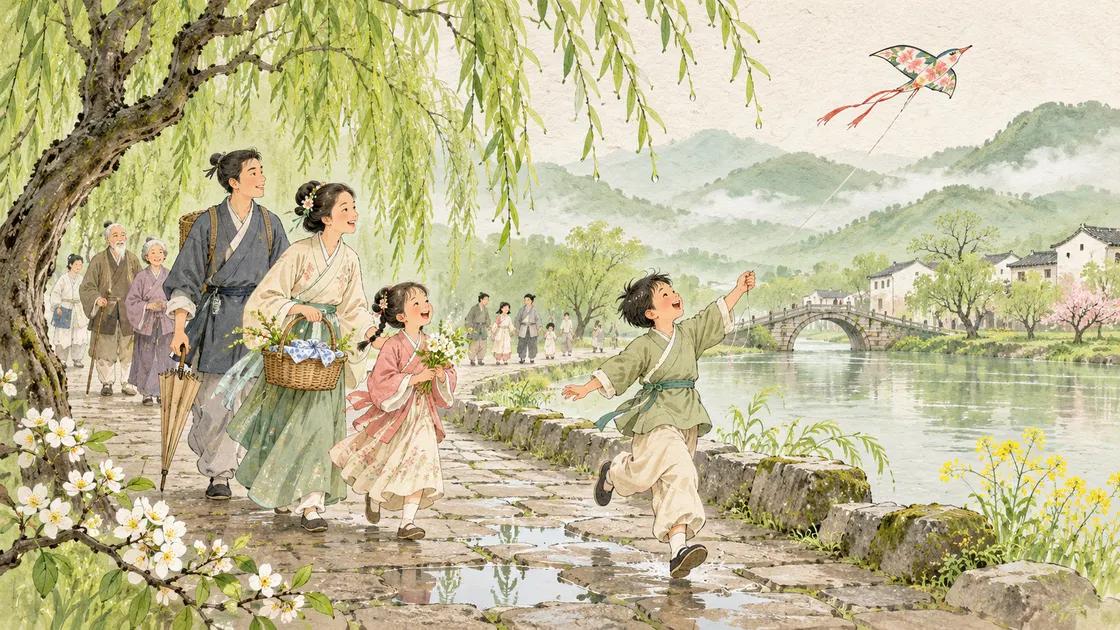
A family tends an ancestral grave. On the same spring day, others go out to see the willows and new growth. Both are part of Qingming.
Qingming Festival is linked to a solar term rather than a fixed lunar date. In 2027, Qingming Day falls on Monday, April 5.
Explore the history and local traditions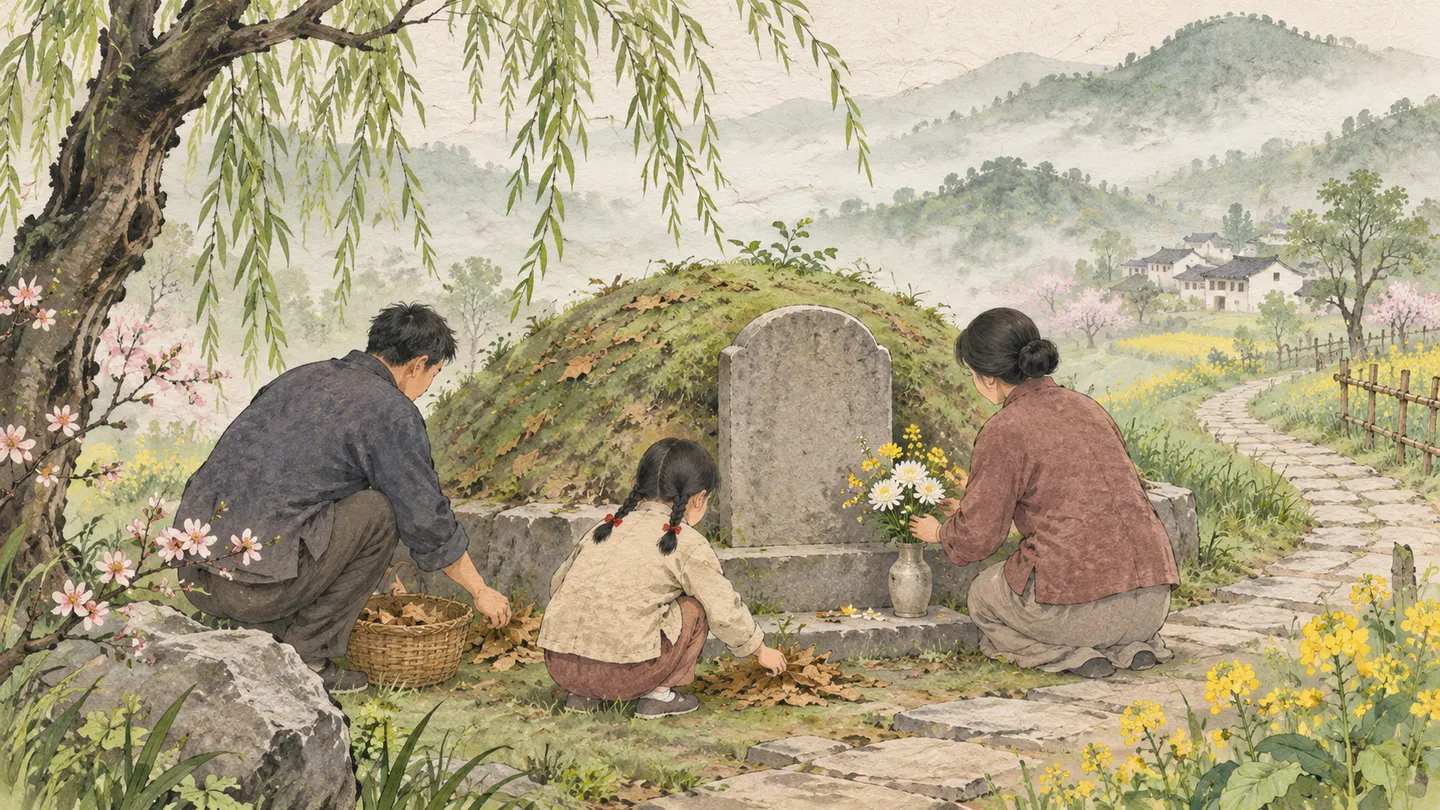
How Qingming and Cold Food came together
Qingming began as a seasonal marker in the twenty-four solar terms. Cold Food, a nearby observance known for avoiding the lighting of fires, contributed customs to the emerging Qingming festival. The historical synthesis compiled by researcher Zhang Na places Qingming’s development as a separate festival after the mid-Tang period. By the Song, it had overtaken Cold Food in prominence.
Two ways families spend the day
A grave visit may include removing weeds, tidying the site and making a family gesture of remembrance. Practices depend on the cemetery, family and locality. Taqing (踏青), a spring outing, is another tradition. One custom centres on remembering the dead, and the other takes people out into the changing landscape.
A solar term and a family observance
- The calendar rule
- Qingming follows a solar term in early April. Its day in the lunar month changes.
- The observance
- Families may visit graves on Qingming or on a nearby day that suits them and the local arrangements.
Qingming follows the solar-term system, so it usually occurs in early April on the Gregorian calendar. Its date must be checked by year. Observance is shaped by family, locality, religion, and local public-holiday arrangements. This page describes cultural context, not a universal prescription for memorial practice.
The history behind Qingming Festival
How did three spring observances come together?
Start with the calendar. Qingming (清明) names a solar term near the beginning of April. Hanshi (寒食), or Cold Food, was an observance close to it, associated with putting out cooking fires and eating food already prepared. Shangsi (上巳), an early spring occasion, had its own customs of going out and gathering in the countryside. These names describe different starting points for practices that eventually shared a season.
The dating and the customs followed different paths. A solar term follows the Sun’s annual cycle and can fall on different lunar dates. The practices followed people: an outing, a grave visit and food prepared in advance could take place in the same few days. Research on the festival system traces Qingming’s rise as an independent festival after the mid-Tang period. By the Song it had overtaken Cold Food in prominence. An older observance could lose its separate place in the calendar while its practices continued under another name.
What does the story of Jie Zitui explain?
In a familiar retelling, Jie Zitui had served the future Duke Wen of Jin during his exile. When the duke came to power, Jie sought no reward and withdrew to a mountain with his mother. The duke, unable to persuade him to return, tried to drive him out by setting the mountain alight. Jie and his mother died in the fire. The duke then ordered people to refrain from lighting fires in remembrance.
The story turns a household act into a memorial gesture: one day without a cooking fire recalls the fire that cost Jie his life. The Shanghai Civil Affairs account transmits the legend in its discussion of Cold Food. The tale explains why the ban made sense in popular memory. The calendar evidence above addresses a different question: how customs associated with Cold Food came to be practised under the name Qingming.
Shanghai Civil Affairs account of Cold Food and the Jie Zitui story
Why do families both tend graves and go out into the spring landscape?
The two actions begin with the same journey out of the home. At a grave, clearing leaves and weeds and arranging flowers or offerings gives a family a practical way to care for a place tied to its history. The visit can also be an occasion to tell children the names of relatives they never met. The timing and form depend on household custom and the site.
Taqing (踏青), a spring outing, turns attention to the living landscape. The term evokes walking out among the new greenery. Historical accounts connect this part of Qingming with nearby spring outing traditions, including Shangsi. A family can undertake a quiet act of remembrance in the morning and enjoy the spring landscape later in the day. The change in mood is part of what the combined festival makes possible.
Zhejiang social-science account of Qingming, Cold Food and Shangsi
What do Qingming foods tell us about regional tradition?
Qingtuan (青团), a green glutinous-rice cake commonly associated with Jiangnan, makes the season visible through its colour. The Qingming food family has regional relatives: the Zhejiang account lists local names such as Qingming ba in Jiangxi and aicao-based cakes known as aīguǒ in some places. A local name may describe a different plant, shape or preparation.
Cold Food customs give one historical context for food eaten around Qingming, while seasonal ingredients help explain why recipes vary from place to place. The two points are compatible. A green cake eaten by one household can be both a memory of older festival food and something made from what is available locally in spring.
Questions about Qingming Festival
When is Qingming Festival in 2027?
Qingming Festival is linked to a solar term rather than a fixed lunar date. In 2027, Qingming Day falls on Monday, April 5.
Is Qingming a lunar festival or a solar term?
Qingming follows one of the 24 solar terms. Its observance usually falls in early April on the Gregorian calendar and does not stay on the same day of a lunar month.
Is Cold Food Festival the same as Qingming?
They have separate historical roots. Cold Food was associated with avoiding cooking fires and eating food prepared in advance. Its date was close to Qingming, and some of its customs became part of the Qingming observance over time.
What do families do on Tomb-Sweeping Day?
Some families visit ancestral graves, clear weeds or leaves, and leave flowers or other offerings. Local rules and family practice shape the visit. Spring outings, called taqing, are also associated with Qingming.
What is qingtuan and why is it eaten around Qingming?
Qingtuan is a green glutinous rice cake eaten around Qingming in parts of southern China, especially Jiangnan. It is associated with seasonal greens and the food customs of Qingming and Cold Food.
Sources and editorial scope
- Hong Kong Observatory Almanac 2026 — Calendar table covering January–December 2027.
- Research on the Chinese traditional festival system
- Zodiac Compass methodology and calculation sources — explains the calendar range used for dates on this site.
This page is a cultural and calendar reference. It does not claim that one legend, custom, or local practice represents every Chinese community.